Year One in the Citrus Belt
21th May, 2026
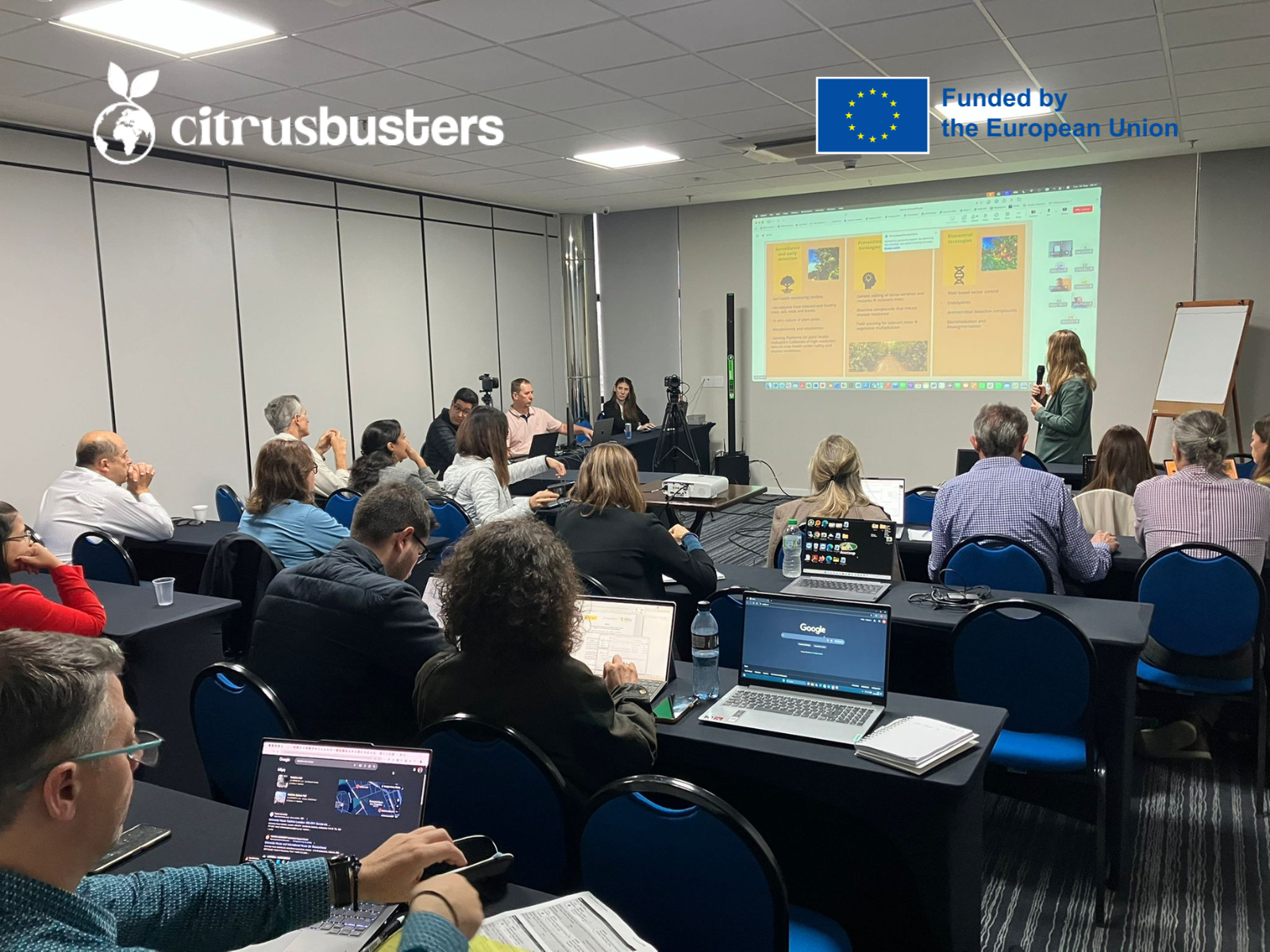
On 19 May, CITRUSBUSTERS came to Limeira, Brazil to share twelve months of research and to plan what comes next. The eleven partners of the CITRUSBUSTERS project crossed continents to meet where citrus protection matters most.
Why is this important?
The reason is straightforward. Huanglongbing, known as HLB, or citrus greening, has already cost Brazilian growers an estimated 30% of their orange groves. The disease and its insect carriers are moving towards Europe. CITRUSBUSTERS exists to be ready when they arrive. A year into a four-year programme, Day 1 of the consortium’s first big in-person review brought the project’s labs and orchards into a single room. Here is what it looked like.
Catching the disease before it shows itself
The morning opened with the question that has driven the project from day one: can citrus greening be detected before a tree shows visible symptoms?
In the Netherlands, Bioclear Earth has been studying the invisible microbial life of citrus orchards. From 200 samples of root, leaf and soil collected in Brazil, the team has built three predictive models that already detect HLB with 71-79% accuracy, using nothing but the bacterial and fungal signatures around the trees. Counter-intuitively, the best signals came not from the soil itself but from the thin layer of microbes that hug the roots and live on the leaves.
From Italy, the CNR team approached the problem from a different angle. After a field campaign in Cordeirópolis last October and another now under way, the team has identified the chemical fingerprint of Phyllosticta citricarpa, the fungus behind Citrus Black Spot. Infected trees emit measurably more of certain terpenes and esters than healthy ones, subtle to the human nose, unmistakable to a lab instrument. A field-ready device that can “smell” the disease is now a realistic prospect.
In Spain, the coordinator AINIA has assembled a full airborne sensing platform. It presents hyperspectral, thermal and LiDAR cameras flown from drones. The first flights have taken place over Spanish orchards, with authorisations in progress for full deployment in Brazil.
Building citrus that can fight back
Prevention took the floor next. And from Limeira came the most arresting field experiment of the year. CCSM-IAC researchers exposed roughly 6,000 sweet orange plants to gamma rays in June 2025, then planted them in Brazilian fields in December with no insecticide and no fungicide. They are now growing under natural HLB and Citrus Black Spot pressure. By December 2026, the team expects to begin evaluating the performance of the mutagenized citrus population under natural disease pressure, with the aim of identifying promising genotypes for further study.
From Madrid, UPM presented a complementary idea that turns a waste stream into a defence. Working with the peels of oranges and mandarins (usually discarded after juicing) the team has extracted water-based fractions that switch on the plant’s own immune system. Early protection tests already show reduced bacterial growth. The citrus industry’s waste, in other words, may turn out to be the citrus industry’s shield.
Building on existing scientific knowledge, ANECOOP and project partners have identified candidate genes associated with disease tolerance and established DNA-free gene editing platforms that might support the future development of more resilient citrus varieties.
Reading the insect’s blueprint
Trioza erytreae, the African citrus psyllid already established in parts of Spain and Portugal, is one of the two main insects that spread HLB. Until now, it had no publicly available genome and no genetic blueprint that researchers could work from. Working with frozen specimens shared by the Instituto Canario de Investigaciones Agrarias, AINIA has assembled the first draft genome of Trioza erytreae. This can open the way to precise, species-specific tools that can switch off vital insect genes without harming anything else.
A complementary path is moving in parallel: sixteen RNA-based molecules designed to silence essential genes in Diaphorina citri, the Asian citrus psyllid, have been synthesised and tested in early experiments. The next round will run in Brazil, where the insect is endemic. On the bacterial front, the team has produced an early endolysin, what is a microscopic protein that can puncture bacterial cells. This protein is derived from bacteriophages associated with Candidatus Liberibacter asiaticus, the bacterium that causes HLB.
From results to framework
CERTH presented the first version of the project’s evaluation framework as a methodology that will measure the environmental, economic and social impacts of CITRUSBUSTERS’ future solutions (LCA; LCC and SoLCA). This methodology was tested during Day 2 in a co-creation workshop with stakeholders.
PEDAL Consulting team summed up twelve months of outreach: a project website, materials in four languages, the first newsletter, and CITRUSBUSTERS’ growing international presence across multiple continents, including presentations at the Global Juice Roadshow in Jakarta, Cairo and Cape Town, the Indian National Citrus Symposium, and IFU events in Lyon and Orlando.
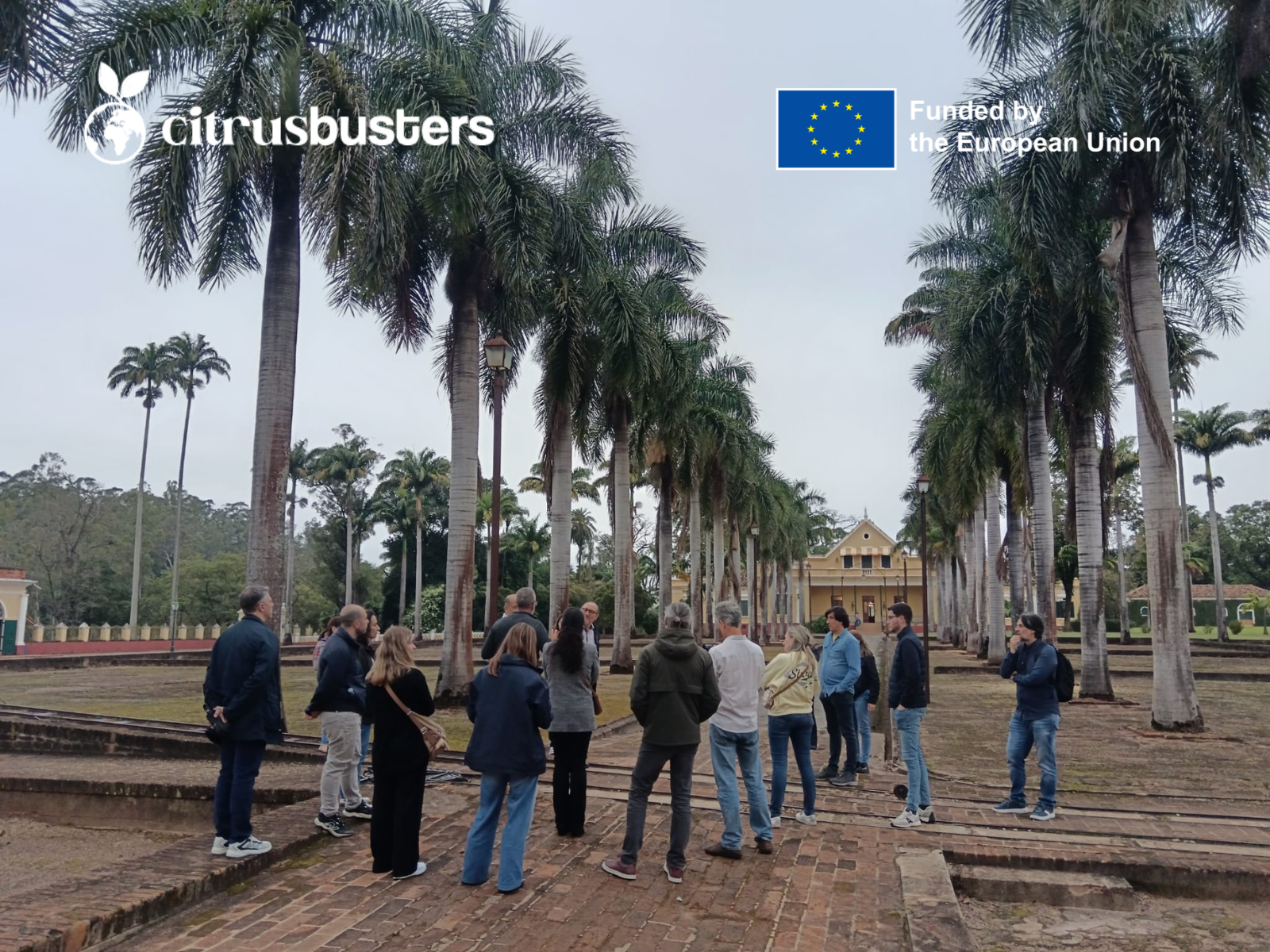
The day closed away from any laboratory. A short drive took the consortium to a 19th-century farm, which served as a reminder that citrus has been part of Brazilian life for nearly two centuries, and that the science being built today inherits that history.
In year two, the first detection tools, resistant trees and biocontrol molecules are expected to move from the lab to the orchards. And the citrus pests, finally, will meet them on the ground.