CITRUSBUSTERS at the Plant Cell Wall Meeting
27 August, 2026
The CITRUSBUSTERS team presented its latest advances in citrus-derived biofractions as plant immunity activators at the XVII Plant Cell Wall Meeting, held in Porto, Portugal, from 15–19 June 2026. The work was presented during Session 12: Cell Walls in Crop Quality, Biomass Utilisation and Sustainability, a session dedicated to innovative approaches for the sustainable use of plant biomass and cell wall-derived products.
The oral presentation was delivered by Miguel Ángel Torres from the Centro de Biotecnología y Genómica de Plantas (CBGP), Universidad Politécnica de Madrid (UPM). Titled “Citrus-derived DAMP biofractions as novel immunity activators against emerging diseases HLB and CBS”, the presentation showcased recent progress from Work Package 2 (WP2) of CITRUSBUSTERS, carried out in collaboration with Meriem Aitouguinane, Gemma López, Lucía Jordá and Antonio Molina.
From citrus residues to plant immunity
The citrus juice industry generates large quantities of peel residues. Although traditionally considered a low-value by-product, these materials are rich in cell wall components such as pectins and other polysaccharides. Within CITRUSBUSTERS, the CBGP-UPM team is exploring how these residues can be transformed into innovative tools for crop protection.
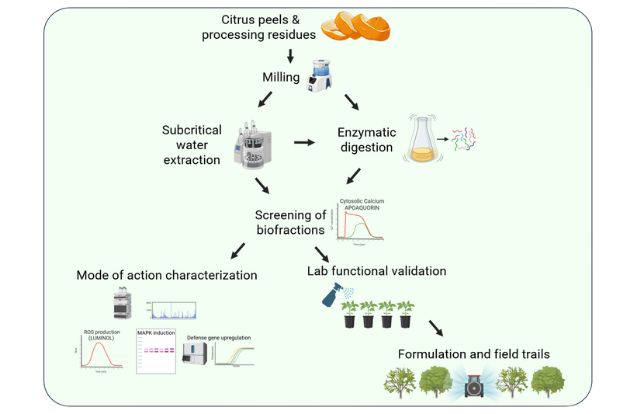
Using environmentally friendly technologies, citrus peels from different crops, including orange and mandarin, are processed through milling, aqueous extraction and controlled enzymatic treatments. These processes generate biofractions enriched in oligosaccharides, small sugars derived from components of the cell walls.
These molecules act as Damage-Associated Molecular Patterns (DAMPs), natural alarm signals that activate plant immune responses. They are generated when plant tissues are damaged and serve as natural alarm signals that warn the plant of danger, triggering immune responses before a pathogen can become established.
The biofractions are screened using Arabidopsis reporter lines that monitor calcium influxes, one of the earliest indicators of immune activation. Several fractions have shown a strong and reproducible capacity to trigger plant defence responses. Their biological activity is being further investigated through biochemical and genetic characterization, allowing researchers to identify the most promising candidates for crop protection.
The next step: testing in citrus
The most active biofractions are currently being evaluated in protection assays using model plants such as Arabidopsis and tomato. Encouraging results have already shown increased resistance against bacterial pathogens. The next objective is to validate these biofractions in citrus plantlets challenged with Huanglongbing (HLB), caused by the bacterium Candidatus Liberibacter asiaticus, and Citrus Black Spot (CBS), caused by the fungus Phyllosticta citricarpa, the two of the main targets of the CITRUSBUSTERS project.
A circular economy approach for sustainable agriculture
This work highlights how agricultural residues can be converted into high-value bioproducts with potential applications in crop protection. By transforming citrus-processing by-products into natural immunity activators, CITRUSBUSTERS contributes to a more circular and sustainable citrus sector, reducing waste while creating innovative alternatives to conventional plant-protection products.
The project demonstrates how knowledge of plant cell walls can be combined with circular economy principles to develop solutions that benefit growers, industry, and the environment alike, contributing to a more resilient and sustainable future for citrus production.
Contact: Miguel Ángel Torres (CBGP-UPM), miguelangel.torres@upm.es