
CITRUSBUSTER at the Meeting of the Italian Society of Plant Pathology
17th September, 2026
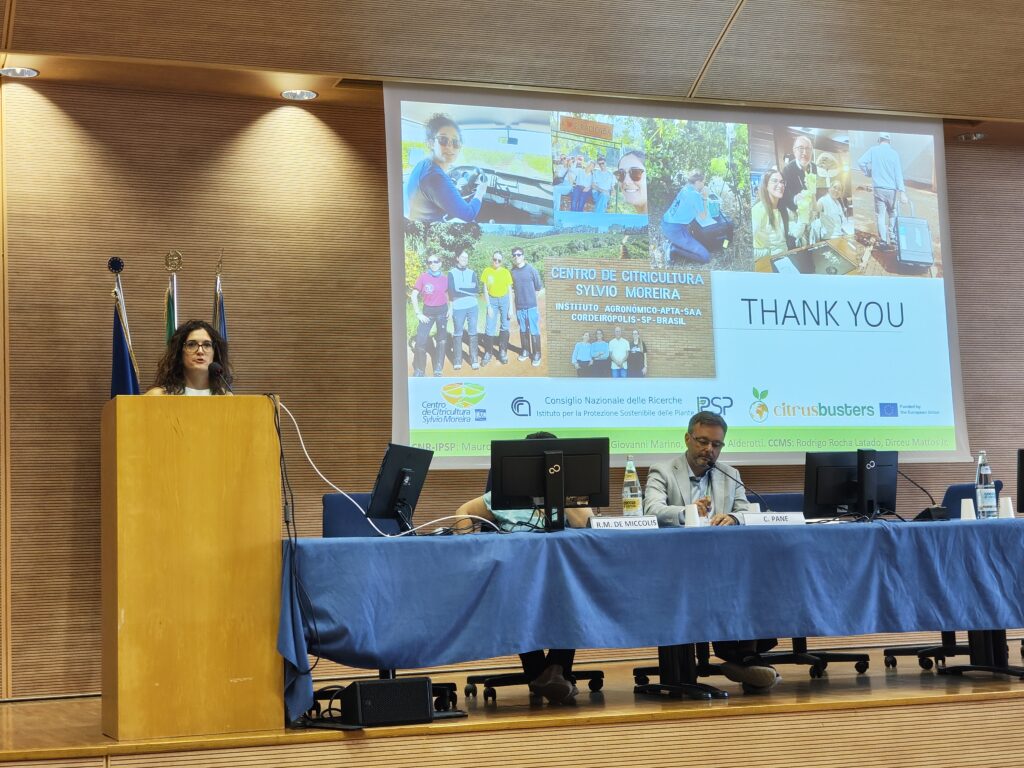
From 16 to 18 September 2026, CITRUSBUSTERS is presenting new results on volatile and metabolic biomarkers of citrus greening disease in Udine, Italy.
The oral presentation is delivered by Valentina Lazazzara, a researcher at the Institute for Sustainable Plant Protection of the National Research Council of Italy (CNR-IPSP). Titled “Volatiles and metabolic biomarkers for early detection of Citrus Greening Disease in Citrus sinensis“, it presents the team’s latest progress from Work Package 1 of CITRUSBUSTERS, carried out together with Cecilia Brunetti, Felicia Menicucci, Giovanni Marino, Francesca Alderotti, Andrea Carolina Baptista Ruiz and Mauro Centritto (CNR-IPSP), in collaboration with Rodrigo Rocha Latado and Dirceu Mattos Jr. from the Centro de Citricultura Sylvio Moreira – Instituto Agronômico (CCSM-IAC) in Brazil.
Two languages of a stressed plant
Plants under stress speak two languages. One is chemistry: the volatile compounds and secondary metabolites they release or reshape as part of their defence system. The other is physiology: what happens to their vital functions, such as photosynthesis, when the disease takes hold. Reading both at once gives researchers a more complete picture of what an infected plant is going through.
That is the approach the CNR-IPSP team has taken to Citrus Greening Disease (Huanglongbing, HLB), caused by the bacterium Candidatus Liberibacter asiaticus. Working with Citrus sinensis cv. ‘Valencia’ plants under both greenhouse and Brazilian orchard conditions, the team combined volatile profiling and metabolomics with direct physiological measurements.
The volatile analysis showed that infection significantly alters the volatile blend released by infected trees. Terpenoids, alkanes, alkenes and ketones contributed significantly to distinguishing healthy from infected plants.
Metabolomics revealed something deeper. In infected plants, the team observed a marked increase and reshaping of phenolic compounds and flavonoids, supporting the occurrence of broad secondary metabolic reprogramming in response to infection.
The price of defence
Yet defending itself has a cost. Physiological measurements showed that infected plants had reduced photosynthetic performance and lower chlorophyll content than healthy ones. Despite the activation of the plant’s defensive metabolism, the disease progressively impairs the tree’s vital functions. In other words, the tree fights back. But not without losing something along the way.
The combination of metabolomics and physiology, the team argues, offers a robust and non-destructive strategy to identify early biomarkers of HLB infection. It also gives researchers new insights into how citrus plants respond to the bacterium, at both chemical and functional levels.
One more step towards earlier and non-destructive detection of HLB through the molecular and physiological signals of infected citrus plants.
Contact: Valentina Lazazzara (CNR-IPSP), valentina.lazazzara@cnr.it